Who Am I?: Practical Detection Engineering for Small Businesses
An alert nobody has tested is an alert you can’t count on. Joel Cabrera of Hunter Strategy and Gabe Abdelgawad, now of TENEX.AI, join AJ King to talk purple team checks on coverage, high-fidelity rules, and free tools like Sigma and BloodHound.
Plenty of small businesses install an EDR, switch it on, and assume the right alerts will show up. Whether they actually fire is a separate question, and answering it is what detection engineering is for. Guest host AJ King, CISO at Hunter Strategy, talks with Joel Cabrera, now Managing Director of Hunter Strategy’s Cyber Fusion Center, and Gabe Abdelgawad, a Senior Detection Engineer at TENEX.AI, who was with Hunter Strategy when this episode was recorded, about how organizations of a few hundred people can find gaps and build detections that match their real risk. They also cover community-edition tooling, quiet days in the SOC, and documenting your tuning.
In this episode
- AJ explains why owning an EDR or SIEM isn’t the same as having working detections, and why a purple team exercise after onboarding is how you find out what actually fires.
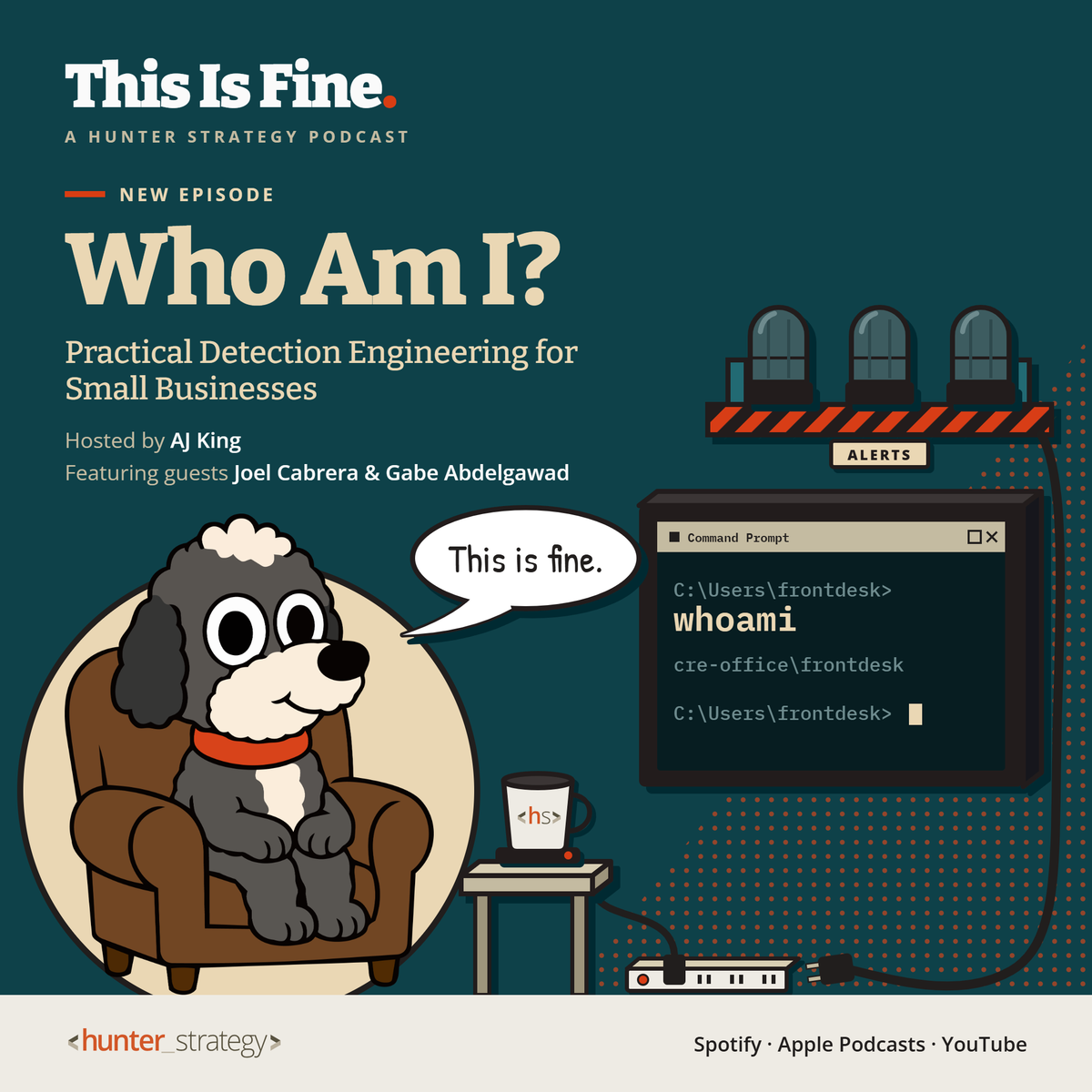
- AJ says a whoami command on an endpoint should be reviewed every time, because attackers often run it right after landing to figure out where they are.
- Joel treats a borrowed detection that won’t work as a clue. Check the log source and event IDs, and filter what reaches your SIEM, for example with Cribl, instead of paying to ingest debug logs.
- Gabe names detection fidelity as the biggest pitfall: a rule doesn’t need to trigger five times a day to be doing its job. AJ adds that ten well-built detections beat a hundred noisy ones.
- On what analysts do when the alerts go quiet, Joel describes threat hunting, such as noticing one account holding hundreds of open sessions. He also suggests a daily roll-up alert that can expose something firing every 42 minutes on the dot.
- AJ argues against outsourcing everything. Having one person on staff who can talk security with vendors keeps you from overpaying and under-receiving.
- Before clicking update on vendor-managed rules, Joel says to copy your tuned version somewhere safe. Gabe closes with advice to own detection mistakes openly and to use LLMs where they save time, as long as you check the results.
Chapters
- 00:00 Intro
- 00:34 AJ sets up the episode and introduces Gabe and Joel
- 01:31 What detection engineering is, and why it starts with knowing your environment
- 04:04 Buying an EDR versus knowing what it detects
- 06:11 Why whoami should always get a second look
- 07:15 Broken detections as a check on your logging and event IDs
08:53 Detection on a small-business budget: the commercial real estate example - 11:35 Choosing between open source and managed SIEM platforms
- 14:33 Pitfall: noisy, low-fidelity detections
- 15:33 What analysts do when alerts are quiet: threat hunting
- 18:16 Why you shouldn’t outsource all of your security
- 19:41 Why detections need continuous refinement
- 20:46 Roll-up alerts that catch beaconing
- 22:00 Detection engineering as learned pattern recognition
- 23:22 Free starting points: Sigma, logging, Have I Been Pwned, and MITRE ATT&CK
- 26:13 Side alerts for what your tools close automatically
- 27:42 Baselines, high-value detections, and building incrementally
- 29:39 Community editions: osquery, BloodHound, Purple Knight, and Cribl
- 31:39 Pitfall: building too fast
- 32:54 Automating rule updates and documenting your tuning
- 34:57 Owning mistakes and team culture
- 35:54 Wrap-up: local communities, VARs, and LLMs
- 37:59 Outro
Mentioned in this episode
- Sigma (open detection rule format and community rule set)
- MITRE ATT&CK (knowledge base of adversary tactics and techniques, the “periodic table” Joel describes)
- Security Onion (free and open platform for threat hunting, network monitoring, and log management)
- Microsoft Sentinel (Microsoft’s cloud SIEM; its Content hub manages out-of-the-box rule updates, and management is moving to the Microsoft Defender portal ahead of the Azure portal retirement on March 31, 2027)
- Google Security Operations (Google’s SIEM and SOAR platform, often called Google SecOps)
- Splunk (SIEM and log analytics platform)
- Cribl Stream (pipeline for routing and filtering log data before it reaches a SIEM; free tier up to 1 TB/day)
- osquery (open source tool for endpoint visibility)
- BloodHound Community Edition (SpecterOps’ free, open source tool for mapping identity attack paths in Active Directory and Entra ID)
- Purple Knight (Semperis’ free security assessment for Active Directory, Entra ID, and Okta)
- TheHive (incident response case management from StrangeBee; free Community license limited to two users)
- Have I Been Pwned (breach notification service)
- Krebs on Security (Brian Krebs’ security news site)
- CISA (U.S. Cybersecurity and Infrastructure Security Agency, source of advisories and free resources)
- ISACs (sector-based Information Sharing and Analysis Centers, coordinated through the National Council of ISACs)
- GDPR (EU data protection regulation)
- ITAR (U.S. export controls on defense articles and services)
Guests: Joel Cabrera, Managing Director, Cyber Fusion Center, Hunter Strategy; Gabe Abdelgawad, Senior Detection Engineer, TENEX.AI
Host: AJ King, CISO, Hunter Strategy (guest host)
This Is Fine is hosted by Matt Triner, who brings in practitioners from federal and commercial work to talk through what it actually takes to keep security, technology, and government contracting running.
🎧 New episodes every Thursday. Subscribe wherever you listen.